

 STEM Learning and Learning Environments
 FUSE Studios: An Alternative Infrastructure for STEM Learning and Interest Development
Effective Years: 2013-2017
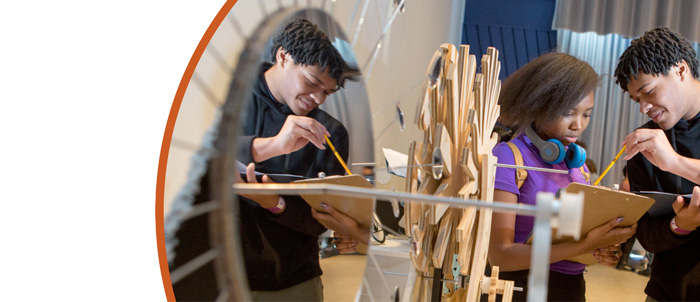
The FUSE Studios project designs a series of learning challenges for youth, derived from principles of game design, to: (1) develop and refine a design-based and iterative research and development cycle that will develop new challenges and new sequences, and revise current challenges; 2) conduct original, multi-faceted research on these new informal learning environments and the learning experiences of participants. The project responds to the failure of formal STEM education practices to engage youth in ways that are meaningful and that fail to engage youth on sustained pathways towards STEM-related careers and involvement in science in later life. In the proposed three year project, building upon pilot work and related evaluation findings from the library-based setting of the youth program, the project investigates research questions that address persistence, the capacity to learn from failure, creative flexibility in problem solving, and choice as powerful indicators of developing interest in and skills related to STEM. The project challenges, called FUSE Studios, are designed to be an alternative structure for STEM learning and interest development. FUSE Studios are organized around sequences of interest-driven challenges, that involve both digital and hands-on activities) that are linked together in a progression modeled after video-game sequences. Participants select a challenge sequence (e.g., robot mini-golf, MP3 amplifier, mobile app development jewelry design using 3D/cad). The research studies patterns of how participants engage with challenge sequences and what they learn when doing so. Participants freely choose resources for meeting the challenges, which provides a unique opportunity to study how participants assemble resources for challenges from the variety of human, web-based and material resources available in the FUSE studios. The project also researches how knowledge and practices circulate among participants. Finally, research will look at whether the project?s approach to iterative, design-based research processes progressively engages a broader representation of youth in STEM. Research uses ethnographic and longitudinal studies, RFID/video capture data, surveys of connected learning and other dimensions, and website-generated activity maps.
7 Publications Related to This Project:
- Learning Inside the School, but Outside the Curriculum: An Extreme Case of Interest-Driven Learning in Alternative Steam Learning Infrastructure for Schools
- From Short Excursions to Long-Term Projects: Agency, Interest and Productive Deviations in School
- The Open Quantum Materials Database (Oqmd): Assessing the Accuracy of DFT Formation Energies
- In-Fuse-Ing Steam Learning with Spatial Reasoning: Distributed Spatial Sensemaking in School-Based Making Activities
- Dilemmas Experienced by Teachers in Adapting to the Role of Facilitator in the Steam Classroom
- Interest Development and Learning in Choice-Based, in-School, Making Activities: The Case of a 3D Printer
- Failure is Just Another Try: Re-Framing Failure in School Through the Fuse Studio Approach
You are viewing a record from the ECR Projects database. Click here to search the ECR Projects Database or the ECR Publications Database.


